

-
Homepage

-
Sealing knowledge
- Klingersil® – Fiber Gaskets from the Klinger Group
What is Klingersil® – Fiber Gaskets from the Klinger Group?
Klingersil® is the brand name of the Austrian Klinger Group for compressed, asbestos-free fiber sealing sheets. In industrial practice, Klingersil is one of the most widely processed flat gasket materials of all. This is not because it is the cheapest, but because it functions reliably across a wide spectrum of media, temperatures, and pressures, and possesses a comprehensive system of approvals. For this reason, you will also find Klingersil® flat gaskets in our sealing product range.
This information page on the Klingersil® brand explains the technical characteristics of the material, which variants the Klinger Group offers, and which type is suitable for which application.

What is Klingersil®?
Klingersil® is a so-called CNAF material – Compressed Non-Asbestos Fiber. This designation describes the manufacturing process: fibers and an elastomer binder are calendered under high pressure into a homogeneous sheet. The result is a dimensionally stable, cuttable sealing material designed for static flange applications.
The fiber gasket material class has been established for decades – it replaced asbestos-containing sealing materials in the 1980s and has not seen a fundamental paradigm shift since then because it simply works. Within this material class, Klingersil is the reference brand: standards, tenders, and technical regulations often explicitly specify Klingersil or equivalent as a requirement.
Klingerit and Klingersil – one concept, two names
In everyday workshop practice in German-speaking regions, anyone speaking of Klingerit means the same material. Klingerit is the older designation, which has persisted in common parlance, technical drawings, and older standards, particularly in Austria and Southern Germany.
The brand name valid today is Klingersil®. Regarding material selection and processing, the difference is irrelevant – both terms refer to fiber sealing sheets from the Klinger Group.
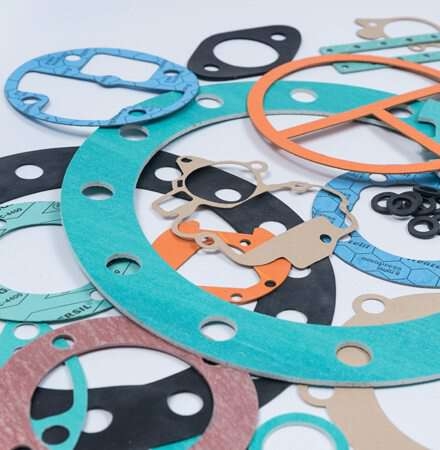
Material Composition: Fibers and NBR as the Core Principle
The classic Klingersil structure is based on two components: high-strength fibers as the mechanical framework and NBR (nitrile rubber) as the binding matrix. The NBR binder seals the fiber structure and provides the material with its resistance to mineral oils, fuels, and aliphatic hydrocarbons.
The decisive difference between the variants lies in the fiber type: C-4400 and C-4430 are based on aramid fibers – known from high-performance applications such as cut protection or brake pads – which ensure compressive strength and dimensional stability. C-4500, on the other hand, relies on carbon fibers with special heat-resistant additives, making this type particularly suitable for alkaline media and high-pressure steam.
Graphite gaskets from the Klinger Group contain no organic fibers at all and are based on expanded graphite – a distinct material type for extreme conditions.

An Overview of Klingersil Variants
The Klinger Group offers several Klingersil types with different performance profiles. The following table shows the most important variants including temperature limits, pressure resistance, and approvals:
| Designation | Characteristics | Temperature Range | Max. Pressure | Key Approvals |
|---|---|---|---|---|
| Klingersil® C-4400 | Universal type; resistant to oil, gas, and solvents | -100 °C to +140 °C | up to 100 bar | DIN-DVGW, BAM (Oxygen) |
| Klingersil® C-4430 | Specialist for steam and drinking water | -100 °C to +140 °C | up to 100 bar | KTW, DVGW W 270, FDA |
| Klingersil® C-4500 | Carbon fiber type; alkaline media, high-pressure steam | -100 °C to +250 °C | up to 100 bar | DIN-DVGW, BAM, DVGW W 270, TA-Luft, Fire-Safe |
| Klingersil® C-4500 SLS | Same as C-4500; smooth surface for low surface pressure | -100 °C to +250 °C | up to 100 bar | Fire-Safe |
| Klinger® Graphite | Expanded graphite; extreme temperatures, aggressive media | -200 °C to +450 °C | up to 250 bar | Fire-Safe, TA-Luft |
| Klingersil® C-4430 Ultra | Further development of C-4430; increased compressive strength | -100 °C to +250 °C | up to 150 bar | KTW, FDA |

Get in touch with us!
We perform best under pressure! Personalized advice for the highest demands and a fast delivery guarantee ensure your satisfaction. Contact our sealing experts.
We look forward to your inquiry."
Klingersil® Approvals: What BAM, DVGW, KTW, and Fire-Safe Specifically Mean
For purchasers and planners, the question of approvals is often more decisive than technical specifications. A Klingersil type without the required approval simply cannot be used in regulated applications—regardless of how well it would seal.
BAM Approval
BAM approval from the Federal Institute for Materials Research and Testing confirms suitability for oxygen-rich environments. It is a mandatory requirement in oxygen plants, as well as in parts of gas and process technology. Among the standard Klingersil types, C-4400 and C-4500 fulfill this requirement.
DVGW Approval
DVGW approval is a prerequisite in Germany for use in gas and drinking water installations. The supplementary test according to DVGW W 270 additionally assesses microbiological behavior in contact with drinking water and is mandatory for drinking water installations – within the Klingersil family, only C-4430 meets this requirement.
KTW Certificate of Suitability
The KTW certificate of suitability (Guideline for the hygienic assessment of organic materials in contact with drinking water from the Federal Environment Agency) certifies that the material does not release substances harmful to health into the drinking water. It is relevant for water supply companies, food technology, and anywhere where direct contact with drinking water exists. FDA compliance according to 21 CFR is the US equivalent and is crucial for international projects in the food and pharmaceutical industries.
Fire-Safe according to DIN EN ISO 10497
Fire-Safe according to DIN EN ISO 10497 is not a material approval in the classical sense, but rather a valve testing standard: it ensures that a seal maintains its sealing effect for a defined period when exposed to direct flames. Fire-Safe suitability is often mandatory in petrochemistry, refinery operations, and other safety-critical plants.
Areas of Application in industrial practice
Klingersil gaskets are used wherever flange connections must remain permanently tight under pressure and temperature. In mechanical engineering and toolmaking, Klingersil C-4400 is the most widely used standard type for pipeline flanges, pump housings, and valves.
In steam systems – saturated steam up to 250 °C – C-4430 has established itself as the reference material because it meets both thermal and regulatory requirements.
In the chemical industry, the choice of type depends on the medium: for organic solvents and mineral oil-based media, C-4400 is the first choice; for inorganic acids, alkalis, or elevated temperatures, C-4500 or Klinger Graphite is utilized.
In drinking water and food supply, the regulatory approval status dictates the choice of C-4430. In petrochemistry and refinery operations, where flange connections must remain tight even in the event of a fire, C-4500 and Graphite types with Fire-Safe certification are the only acceptable materials.

Get in touch with us!
We perform best under pressure! Personalized advice for the highest demands and a fast delivery guarantee ensure your satisfaction. Contact our sealing experts.
We look forward to your inquiry."
Klingersil® at Kofler - Dichtungen
Kofler - Dichtungen stocks Klingersil® C-4400, C-4430, and C-4500 and processes them via waterjet cutting according to drawings, flange standards, or samples – even for quantities as small as a single piece. As an alternative to Klingersil, Kofler - Dichtungen offers Frenzelit Novapress® gaskets, a fiber material with a comparable property profile that represents an economically viable option for certain applications.

FAQs regarding Klingersil®



What is the difference between Klingersil C-4400 and C-4430?
Is Klingersil suitable for oxygen lines?
Up to what temperature can Klingersil be used?
Can Klingersil be used for drinking water?
What is the difference between Klingersil and graphite gaskets?
